
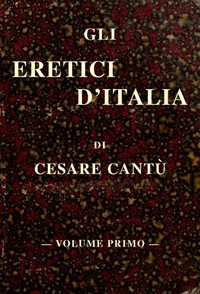
Gli eretici d'Italia, vol. I by Cesare Cantù
Cesare Cantù's Gli eretici d'Italia is a history book that reads like a collection of urgent, human stories. Published in the 19th century, it focuses on the period from the late Middle Ages through the Renaissance, a time when the Catholic Church's power was nearly absolute in Italy.
The Story
There isn't one single plot, but a series of interconnected narratives. Cantù acts as a guide, taking us through the lives of Italians accused of heresy. He shows us not just famous figures, but regular people—weavers, merchants, monks—who ran afoul of the Inquisition. The "story" is their collective struggle. We see how ideas considered dangerous, like those of the Waldensians or later Protestant reformers, trickled into Italy. We follow the mechanisms of control: secret denunciations, tense interrogations, and the looming threat of punishment. The book paints a vivid picture of a society where your private thoughts could become a public crime.
Why You Should Read It
This book surprised me. I expected a dry academic text, but Cantù has a novelist's eye for detail. He lets the historical records speak for themselves, and the voices that come through are full of fear, defiance, and conviction. You get a real sense of the terrible weight of the choice these people faced: recant your beliefs or lose everything. It’s not a simple story of good versus evil; Cantù shows the complexity on all sides. What stuck with me most was the sheer ordinary humanity of the so-called heretics. Their desires—to understand scripture, to worship freely—feel incredibly modern. It makes the historical drama painfully personal.
Final Verdict
Perfect for readers who love narrative history that focuses on people over politics. If you enjoyed books like The Name of the Rose or are fascinated by the Renaissance, this is your next deep dive. Be prepared: it's a dense, detailed work (it's only Volume I, after all), so it's best taken in chunks. It’s not a light beach read, but for anyone curious about the roots of religious freedom, dissent, and how societies enforce conformity, it’s a profoundly rewarding and thought-provoking experience. You’ll look at this pivotal era in a completely new light.
This is a copyright-free edition. Thank you for supporting open literature.
Matthew Garcia
1 year agoI had low expectations initially, however the arguments are well-supported by credible references. Absolutely essential reading.
Edward Williams
7 months agoThanks for the recommendation.
Charles Perez
1 year agoWow.






Aiden Taylor
1 year agoSimply put, the flow of the text seems very fluid. I would gladly recommend this title.