
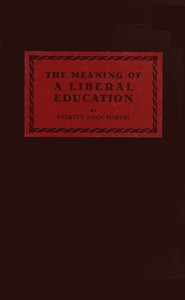
The meaning of a liberal education by Everett Dean Martin
Published in 1926, Everett Dean Martin's The Meaning of a Liberal Education doesn't have a plot in the traditional sense. There are no characters or twists. Instead, it presents a powerful and persistent argument. Martin, a minister and educator, was deeply worried about the state of public discourse. He watched propaganda flourish after World War I and saw people increasingly swayed by emotion and groupthink rather than reason.
The Story
Think of this book as a guide to intellectual self-defense. Martin defines a 'liberal education' not as a set of classes you take, but as a lifelong habit of mind. It's the training to think for yourself, to question easy answers, and to resist the pull of the crowd. He breaks down how propaganda works, why we're so susceptible to it, and why cultivating a disciplined, questioning intellect is the only real antidote. The 'story' is his journey through these ideas, showing how a failure of education leads directly to a failure of democracy.
Why You Should Read It
I picked this up expecting a dusty academic lecture. What I found was a book that felt urgent and immediate. Martin's description of 'herd psychology' and the 'mob mind' could be a critique of today's social media algorithms and cable news cycles. His core message—that freedom requires mental effort—is a challenging but necessary one. It made me examine my own thinking. How often do I go along with my 'tribe'? When do I choose the comforting opinion over the complicated truth? This book is a mirror, and it doesn't always show a flattering reflection, but it's a crucial one.
Final Verdict
This is a perfect read for anyone feeling uneasy about the quality of our public conversations. It's for the person who asks, 'How did we get here?' and is willing to look for answers beyond today's headlines. History buffs will appreciate its period context, teachers and students will find its core philosophy vital, and any thoughtful citizen will gain a powerful framework for understanding the world. Fair warning: it's not a light read. It demands your attention. But if you give it, you'll come away with a sharper, clearer perspective on the noise of the modern world. It’s a classic that, sadly, feels more relevant than ever.
This is a copyright-free edition. Access is open to everyone around the world.
Donna Miller
9 months agoFrom the very first page, the atmosphere created is totally immersive. One of the best books I've read this year.


Jackson Williams
11 months agoRead this on my tablet, looks great.