
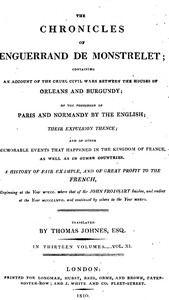
The chronicles of Enguerrand de Monstrelet, Vol. 11 [of 13] : containing an…
So, what's actually going on in Volume 11? We're in early 15th-century France, and the country is in absolute chaos. The English are a constant threat, but the real bloodshed is happening between Frenchmen. Two powerful factions—the Armagnacs and the Burgundians—are locked in a vicious civil war for control of the mad King Charles VI and the kingdom itself.
The Story
Monstrelet doesn't give us a neat, packaged narrative. Instead, he chronicles events almost like a news reporter, moving from city to city, castle to castle. We see the brutal siege of Bourges, the tense negotiations that go nowhere, and the sudden, shocking acts of violence that change the course of everything. Key figures like John the Fearless, Duke of Burgundy, and the Dauphin (the future Charles VII) are constantly maneuvering, making alliances one day and breaking them the next. The line between politics and outright warfare is paper-thin. It's a confusing, fast-paced, and often horrifying snapshot of a nation eating itself alive.
Why You Should Read It
Here's the magic of Monstrelet: he removes the centuries of polish. This isn't history filtered through a modern lens. You get the immediate, often bewildered perspective of a contemporary. The writing is direct. He tells you who marched where, who said what at a meeting, and the grim aftermath of a sacked town. You feel the pervasive uncertainty. You realize that for the people living through it, there was no "story"—just a desperate struggle to survive the next crisis. It makes the past feel immediate and human, not like a chapter in a textbook.
Final Verdict
This is not a book for someone looking for a light, novelized historical romp. It's for the reader who wants to get their hands dirty in the primary sources. Perfect for history buffs who have read the popular summaries and now want to see the real, unvarnished material, or for anyone fascinated by the messy reality of power, betrayal, and survival. Be prepared to cross-reference names and keep a map handy. The reward is the feeling of listening to a voice from the very heart of the storm.
This masterpiece is free from copyright limitations. Share knowledge freely with the world.
John Harris
1 year agoI have to admit, the content flows smoothly from one chapter to the next. This story will stay with me.
Sandra King
1 year agoHigh quality edition, very readable.
Christopher Jones
11 months agoHaving read this twice, the storytelling feels authentic and emotionally grounded. Exceeded all my expectations.